


Roman Persecution of Jews: The Trials That Forged
Roman Persecution of Jews: The Trials That Forged Our Mesorah
 Hindy Blum •February 11, 2026• 13 min read•
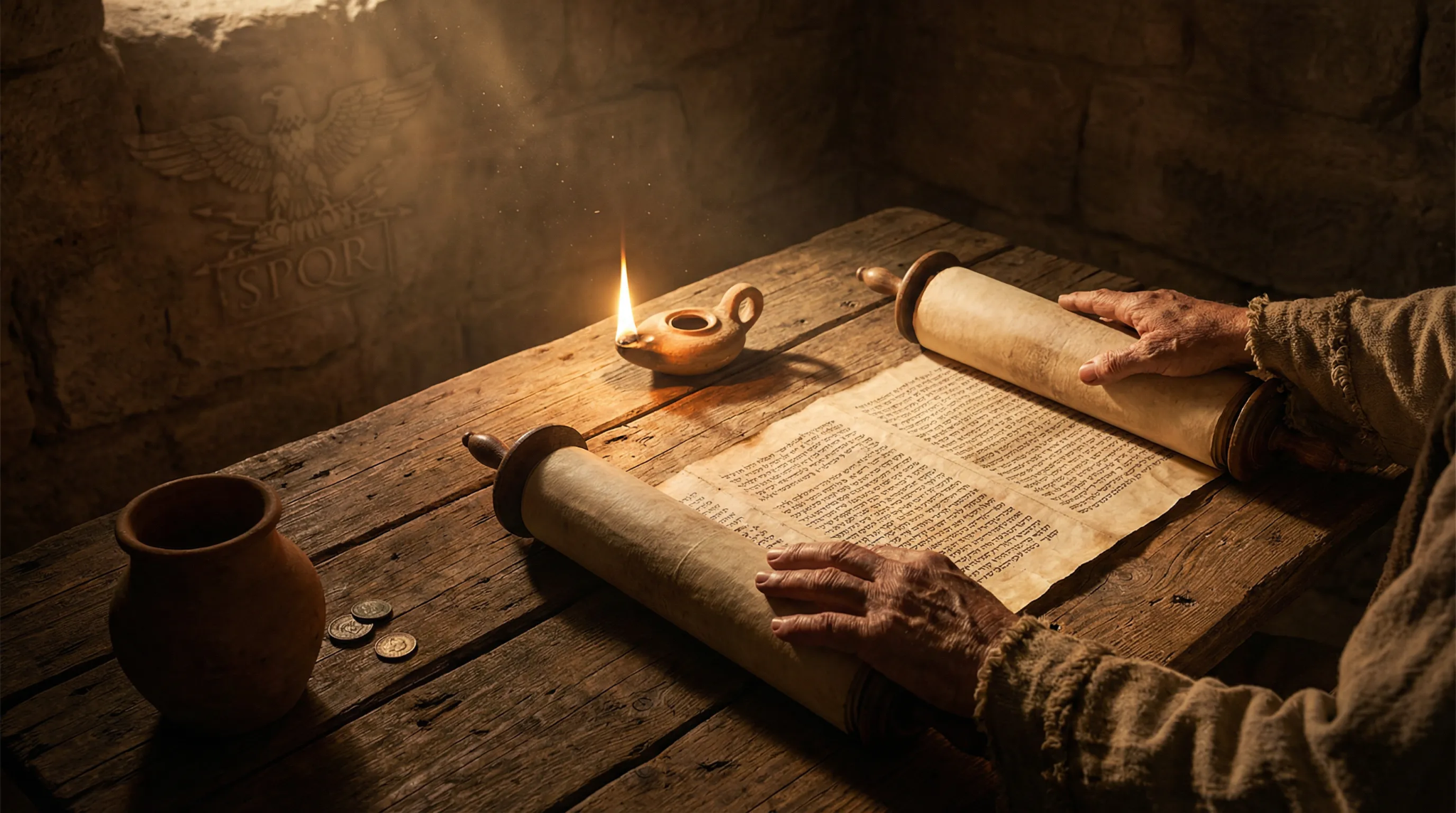
Alt text: Ancient hands unrolling a Torah scroll by oil lamplight in a stone chamber during the Roman era, symbolizing the preservation of Jewish tradition through persecution
From the moment Roman legions first marched into Yerushalayim (Jerusalem) in 63 BCE, our ancestors faced a long and painful struggle to preserve the mesorah (tradition) under foreign rule. Over time, and especially during the periods of open persecution and anti-Torah decrees, Rome sought not only to dominate the Jewish people politically, but to uproot the covenantal life that bound them to Torah. Yet Rome was not fighting a people clinging to Torah as a treasured custom alone. It was confronting a nation that understood Torah to be its very life.
That is why the destruction of the Beis HaMikdash (Holy Temple), the brutal Hadrianic decrees, and the martyrdom of our greatest Tannaim (sages of the Mishnah) did not break the chain of transmission. These were the trying times during which our Oral Torah was refined, preserved, and handed down from generation to generation, until it reached our own hands.
Understanding the Roman era Judaism that produced figures like Rabbi Akiva and Rabbi Meir Baal Haness deepens our appreciation for every daf of Gemara we learn today. Rabbi Meir Baal Haness Charities, founded in 1799, continues the legacy born from that era, ensuring that Torah scholarship and support for the needy in Eretz Yisroel endure, just as our ancestors ensured the mesorah would survive Rome’s cruelest designs.
The Rise of Roman Rule Over Eretz Yisroel
Rome’s grip on Eretz Yisroel began in 63 BCE when the general Pompey besieged and conquered Yerushalayim, entering the Beis HaMikdash itself. Initially, Rome permitted a degree of Jewish autonomy under Hasmonean client rulers such as Hyrcanus II, and later under Herod. But this arrangement was always fragile, resting on Rome’s willingness to tolerate a people whose allegiance belonged to HaKadosh Baruch Hu (the Holy One, Blessed Be He) above any earthly emperor.
As decades passed, Roman-appointed procurators grew increasingly hostile. The Gemara and historical sources record escalating provocations, taxation that bled the populace dry, interference with the avodah (Temple service), and outright theft from the Temple treasury. By the time Gessius Florus plundered sacred funds in 66 CE, the breaking point had arrived. The First Jewish-Roman War (66–73 CE) erupted, pitting a fiercely loyal nation against the mightiest military force in the ancient world.
This period is essential context for understanding the world into which Rabbi Meir was born. The political landscape of Roman jewish relations during this era was not merely uncomfortable, it was existential. Every decision made by the Chachomim (Sages) in these years carried the weight of national survival.
Churban Beis HaMikdash: The Devastation That Changed Everything
In the year 70 CE, Titus and his Roman legions breached the walls of Yerushalayim and destroyed the Second Beis HaMikdash. The Gemara in Gittin 55b–56a preserves searing accounts of the siege, the famine, and the infighting that hastened the destruction. Hundreds of thousands perished. Countless more were sold into slavery. The Fiscus Judaicus, a humiliating tax imposed on every Jew in the empire, replaced the shekalim that had once supported the avodah.
Three years later, in 73 CE, the fortress of Masada fell. The physical infrastructure of Jewish national life lay in ruins. Yet even amid the ashes, the seeds of renewal were already planted. The Gemara in Gittin 56a-b recounts how Rabban Yochanan ben Zakkai, smuggled out of besieged Yerushalayim in a coffin, stood before the Roman general Vespasian and asked for one thing: “תן לי יבנה וחכמיה”, “Give me Yavneh and its sages.” This single request preserved Torah She’b’al Peh (the Oral Torah) at the moment of its greatest peril.
The Churban (destruction) did not end our story. It transformed it. The center of Torah life shifted from the Beis HaMikdash to the beis midrash (study hall), from Yerushalayim to Yavneh, and later to the Galilee. Every page of Gemara we learn today exists because of that shift, because our Chachomim understood that Torah itself was the true sanctuary, one no army could ever destroy.
The Hadrianic Decrees and the War Against Torah
If the Churban was a devastating blow to our nation’s body, the Hadrianic decrees were an assault on its neshamah (soul). After the Bar Kochba revolt of 132–135 CE was crushed, the Emperor Hadrian enacted a systematic campaign to eradicate Jewish identity from Eretz Yisroel. The Gemara in Rosh Hashanah 19a records that Rome prohibited Torah study, bris milah (circumcision), and Shabbos observance, striking at the very pillars of Jewish life.
Hadrian renamed Yerushalayim as “Aelia Capitolina” and barred Jews from entering the city. The province of Yehudah was renamed “Palaestina” in a deliberate attempt to sever our connection to the land promised to Avraham Avinu. According to the account in the Yerushalmi (Ta’anis 4:5), approximately 500,000 Jews were killed and 985 villages were razed during the revolt and its aftermath.
This was not persecution born of political expediency alone. It was a war against Torah itself, an attempt to break the covenant between Klal Yisroel and the Ribbono Shel Olam (Master of the Universe). And it is in this furnace of suffering that torah study under persecution became the supreme act of defiance.
The Ten Harugei Malchus: Sanctifying Hashem’s Name
The Roman persecution of Jews reached its most sacred and terrible expression in the martyrdom of the Asarah Harugei Malchus (Ten Martyrs of the Kingdom). Among these towering figures was Rabbi Akiva, the primary teacher of Rabbi Meir. The Gemara in Berachos 61b describes Rabbi Akiva’s final moments with unforgettable clarity: as the Romans combed his flesh with iron combs, he recited the Shema, accepting upon himself the yoke of Heaven. His talmidim (students) asked him, “Rebbi, even to this extent?” He replied: “כל ימי הייתי מצטער על פסוק זה… עכשיו שבא לידי לא אקיימנו”, “All my days I was troubled by this verse [‘with all your soul’], now that it has come to my hand, shall I not fulfill it?”
We recite the account of the ten martyrs in our tefillos (prayers) on Yom Kippur and Tisha B’Av, serving as a declaration: the mesorah survived because these kedoshim (holy ones) chose death rather than abandon Torah. After his teacher’s execution, Rabbi Meir carried this legacy forward. His very life’s work, preserving and transmitting the Oral Torah, was an answer to Rome’s attempt to silence it forever.
Rabbi Akiva, Rabbi Meir, and the Survival of Torah She’b’al Peh
The Gemara in Sanhedrin 86a establishes a foundational principle: “סתם מתניתין רבי מאיר”, “An anonymous Mishnah follows Rabbi Meir.” This means that a vast portion of the Mishnah as we know it bears the imprint of Rabbi Meir’s formulation. But we must appreciate the context: Rabbi Meir received this Torah from Rabbi Akiva, who himself systematized the Oral Torah during the most dangerous period in Jewish history.
Rabbi Akiva, active during the years leading up to and through the Bar Kokhba revolt (approximately 120–135 CE), devoted his life to organizing the teachings of Torah She’b’al Peh into structured categories. After his martyrdom, it fell to his surviving students, preeminently Rabbi Meir, to carry this work forward. The Gemara in Eruvin 13b testifies to Rabbi Meir’s extraordinary brilliance: “שלא יכלו חבריו לעמוד על סוף דעתו”, “His colleagues could not fully grasp the depth of his reasoning.”
With the great academies destroyed, the sages scattered, and Rome hunting anyone who dared teach Torah, Rabbi Meir and his contemporaries gathered at the usha synod in the Galilee and rebuilt. They reconstituted the Sanhedrin, resumed public teaching, and ensured that the teachings of their martyred teachers would not be lost.
The Yerushalmi indicates that in areas such as Eruvin and public fasts, halacha followed Rabbi Meir.” His halachic authority in these areas, areas directly tied to communal Jewish life and practice, reflects the trust placed in him by the generation that rebuilt after the Churban and the Hadrianic persecutions. Every time we learn a stam Mishnah today, we are hearing the voice of Rabbi Meir, preserved across nearly two thousand years of unbroken transmission.
Continue Rabbi Meir’s Legacy, Give Tzedakah in His Memory
How Persecution Revealed Klal Yisroel’s Unwavering Commitment to Torah
It would be natural to look at the Roman persecution of the Jews and expect to see only destruction. However, much to their frustration, as much as the Romans could destroy buildings, ban public teaching, and threaten death, they could not sever Klal Yisroel from Torah. In Berachot 61b, when Rabbi Akiva continued teaching Torah in public despite the decree, and Pappos ben Yehudah warned him that it was dangerous, Rabbi Akiva explained his defiance to the Roman decree with a parable of the fish and the fox that cuts to the heart of the matter. A fox once saw schools of fish scurrying nervously through the water and asked them why they were fleeing. The fish answered that they were afraid of the fishermen’s nets. The fox suggested that they come out of the water and live with him on dry land, where they would be safe. The fish answered that if they were in danger even in the water, which is the source of their life, then outside the water they would certainly die.
The nets represent persecution, pressure, and mortal danger. The fox offers what sounds like a practical solution: leave the place of danger and survive another way. But the fish understand that his advice is absurd. Outside the water there is no life at all. In the same way, Rabbi Akiva taught that Torah is not an added layer of Jewish life, something to hold onto when conditions are favorable and set aside when the cost becomes too high. Torah is the environment in which a Jew lives. To abandon it for the sake of safety is not to preserve life, but to leave the water.
Rabbi Akiva’s response did not deny the danger. He acknowledged it fully. The nets were real. Rome was real. The threat of death was real. But he taught that separation from Torah is a deeper danger still. Torah is not merely our belief system or our heritage. It is our oxygen, our sustenance, our very life. That is why the decree against Torah study could never be met with surrender. It could only be met with deeper attachment.
As remembered in the words of Eleh Ezkerah, a lament about the Asarah Harugei Malchus — the Ten Martyrs, the great sages killed by the Romans, they did not meet their end with retreat or compromise, but with dignity, faith, and unwavering attachment to Hashem and His Torah. Their greatness was not only that they died al kiddush Hashem, but that they lived as men for whom Torah was more precious than comfort, safety, or even life itself. In them, Klal Yisroel saw that mesiras nefesh for Torah was not the sacrifice of one heroic individual alone, but the crown of an entire generation of sages who refused to let persecution loosen their hold on eternity. The Gemara records Rabbi Akiva’s final moments, when he accepted the yoke of Heaven while being tortured and drew out the word “One” as his soul departed. His life and death together teach the same lesson: Torah and devotion to Hashem are not suspended in times of persecution; they are revealed in their full depth.
This is the enduring greatness of Klal Yisroel under persecution. The enemy imagines that suffering will force the Jew to loosen his grip on Torah. Again and again, the opposite happens. The more the world presses against Torah, the more clearly its faithful bear witness that without Torah there is no Jewish life at all. The fish remain in the water. The sages continue to teach. The martyrs sanctify Hashem’s Name. And through them all, Klal Yisroel declares that Hashem’s Torah is not a burden we carry, but the life from which we draw breath.
From Destruction to Renewal: The Legacy We Carry Today
After Hadrian’s death in 138 CE, his successor Antoninus Pius gradually eased the harshest decrees. Torah study resumed more openly. The Galilee, with centers like Usha, Tiberias, and Tzippori, became the heartland of rabbinic scholarship. Within a few generations, Rebbi (Rabbi Yehuda HaNasi) compiled the Mishnah, drawing heavily on Rabbi Meir’s teachings and ensuring that the Oral Torah would never again be at risk of being forgotten.
The story of Roman persecution of Jews is, in the end, a story of what we built from the ashes. The Talmud Bavli and Yerushalmi, the halachic codes, the commentaries of the Rishonim and Acharonim — all of it flows from the decisions made by Rabbi Akiva, Rabbi Meir, and their contemporaries to keep learning, keep teaching, and keep transmitting Torah despite mortal danger. Their bitachon (trust in Hashem) was not passive. It was active, courageous, strategic, and suffused with mesiras nefesh. They understood that Torah is our life, and therefore they were prepared to give up comfort, safety, and even life itself rather than let the chain of mesorah be broken. What they handed forward was not only teaching, but a living example of what it means for Klal Yisroel to cling to Hashem’s Torah under fire.
Today, when we support Torah institutions in Eretz Yisroel, we participate in this same chain of transmission. Rabbi Meir Baal Haness Charities, founded in 1799, exists to ensure that Torah scholars, widows, and orphans in the Holy Land receive the support they need, continuing the work of sustaining Torah life that began in those desperate post-Churban years. By giving tzedakah (charitable giving) in Rabbi Meir’s zechus (merit), we declare that what Rome tried to destroy still stands, still grows, still illuminates.
Conclusion
The Roman persecution of Jews was among the darkest chapters our nation has endured. Empires rose and fell, armies marched across the Holy Land, and decrees sought to sever us from our Torah, our land, and our Maker. Yet the mesorah not only survived, it flourished. Rabbi Akiva gave his life for it. Rabbi Meir dedicated his genius to preserving it. And we, their spiritual descendants, are entrusted with carrying it forward.
Every act of Torah study, every act of chesed (kindness), and every contribution of tzedakah in the merit of Rabbi Meir Baal Haness connects us to that unbroken chain. By giving through Rabbi Meir Baal Haness Charities, you sustain Torah scholars and needy families in Eretz Yisroel, the very land where our ancestors chose faithfulness over survival, and in so doing, secured both.
In the merit of Rabbi Meir Baal Haness, may you be blessed with the strength of emunah that no trial can diminish, and may the Torah you support illuminate the world until the coming of Moshiach, speedily in our days.





