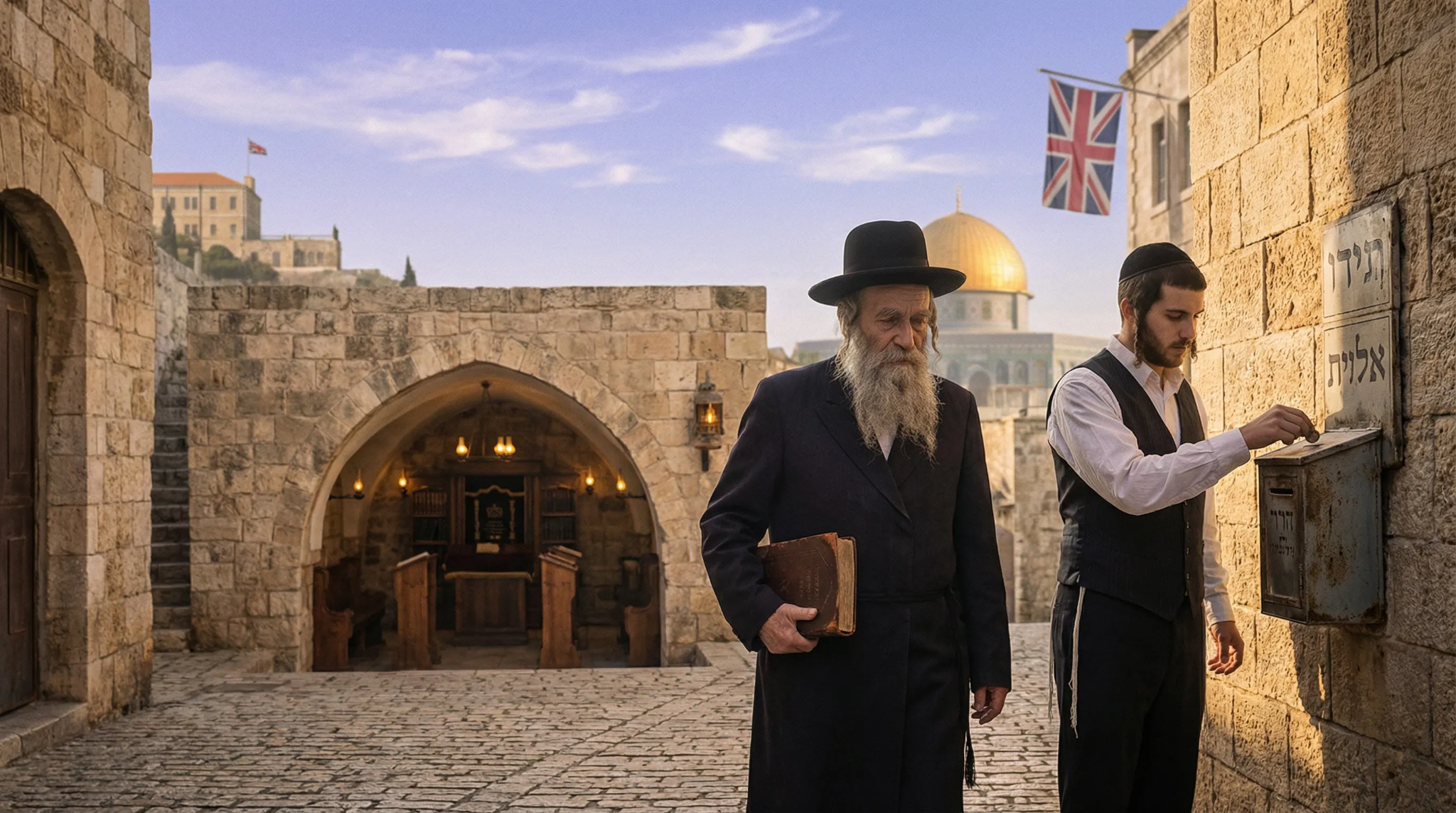
The decades of British rule over Eretz Yisroel shaped the future of Jewish life in ways we are still feeling today. From the collapse of the Ottoman Empire through the turbulent decades of British administration, our communities in the Holy Land faced upheaval, persecution, and the constant test of emunah (faith). Yet through it all, the Yidden of Eretz Yisroel clung to Torah, to chesed (lovingkindness), and to one another.
Understanding this era is part of knowing our mesorah (tradition), how the Torah communities we cherish today survived against extraordinary odds. What follows is a Torah-grounded look at British Mandate Palestine, the forces that shaped it, the Gedolim who guided our people through it, and the lessons of bitachon (trust in Hashem) and tzedakah (charitable giving) that emerged from one of the most consequential periods in modern Jewish history.
Rabbi Meir Baal Haness Charities, founded in 1799, was already active long before the British arrived, sustaining the poor of Eretz Yisroel through generations of hardship. Explore how this sacred organization continues Rabbi Meir’s legacy of supporting needy families in the Holy Land through Reb Meir’s Guarantee.
Key Takeaways
- British Mandate Palestine (1923–1948) transformed the legal, economic, and social framework of Jewish life in Eretz Yisroel after four centuries of Ottoman rule.
- The Balfour Declaration of 1917 was embedded into the Mandate’s terms, boosting Jewish immigration while creating tension between secular newcomers and the established Torah communities.
- Towering Gedolim—including Rav Kook, Rav Yosef Chaim Sonnenfeld, and the Chazon Ish—guided communities through violence, political uncertainty, and the 1929 Chevron massacre.
- Tzedakah networks like the chalukah system and Rabbi Meir Baal Haness Charities, founded in 1799, served as the economic backbone that kept Torah scholars, widows, and orphans sustained throughout British Mandate Palestine.
- Britain’s 1939 White Paper restricted Jewish immigration at the very moment European Jews most desperately needed refuge, underscoring that political promises alone could never secure Jewish survival.
- The enduring lesson of this era is that empires rise and fall, but Torah life in Eretz Yisroel has persisted through Torah, tefillah, and the unbroken chain of chesed that continues to this day.
The Fall of the Ottoman Empire and the Dawn of British Rule
For four centuries (1517–1917), the Ottoman Empire governed Eretz Yisroel. Jewish communities in Yerushalayim, Chevron, Tzfas, and Teverya, the four holy cities, lived under Ottoman administration. The Tiberias jewish history of this period reflects a kehillah that endured earthquakes, poverty, and political neglect, yet never abandoned its connection to the sacred soil.
World War I shattered the Ottoman order. British forces under General Edmund Allenby entered Yerushalayim in December 1917, and by the war’s end, Palestine had passed from Ottoman to British hands. The League of Nations formally granted Britain the Mandate for Palestine, which came into force in September 1923. This was not simply a change of flag. It was a transformation of the entire legal, economic, and social framework governing Jewish life in the Land.
For the Torah communities, the transition brought both hope and uncertainty. The Ottomans had allowed a degree of religious autonomy through the millet system, a form of governance that granted non-Muslim communities—such as Greek Orthodox Christians, Armenian Christians, and Jews—the right to manage their own religious, educational, and legal affairs under their respective religious leaders. But now our kehillos had to navigate an entirely new governmental structure, one shaped by European political interests rather than the familiar, if imperfect, patterns of ottoman Jewish sites and communal governance they had known for generations.
The Balfour Declaration and Its Impact on Yishuv Life
On November 2, 1917, British Foreign Secretary Arthur James Balfour issued a declaration stating that His Majesty’s Government viewed with favour the establishment of a national home for the Jewish people in Palestine. This single document reshaped the trajectory of Jewish settlement in Eretz Yisroel for decades to come.
The Balfour Declaration was incorporated into the terms of the British Mandate itself, giving it legal weight under international law. As a direct result, Jewish immigration, aliyah, increased significantly during the 1920s and 1930s, bringing waves of newcomers to the Yishuv (the Jewish community in pre-state Eretz Yisroel). For the existing Torah communities, this meant both opportunity and challenge. New arrivals brought resources and energy, but many came with secular ideologies that sat uneasily alongside the deeply religious character of the old Yishuv.
At a meeting in July 1922, Balfour and Prime Minister Lloyd George reportedly confirmed to Chaim Weizmann that by the Declaration they had always envisioned an eventual Jewish state. Yet the practical reality on the ground was far more complicated. British policy shifted repeatedly, sometimes encouraging Jewish settlement and sometimes restricting it sharply, depending on political pressures from both the Arab population and changing priorities in London. The Torah community watched these developments with a mixture of cautious hope and deep reliance on the Ribbono Shel Olam, knowing that the fate of Eretz Yisroel eventually rests in Hashem’s hands, not in the declarations of any earthly government.
Torah Communities in Eretz Yisroel Under the Mandate
Even though the political upheaval, the decades of British Mandate Palestine were a period of remarkable growth for Torah life in Eretz Yisroel. Yeshivos expanded, batei din (Jewish religious courts) functioned, and the infrastructure of frum (observant) communal life—shuls (synagogues), mikvaos (ritual baths), chedarim (religious schools), and tzedakah (charity) networks, deepened its roots in the holy cities and beyond.
The old Yishuv, centered in Yerushalayim, Chevron, Tzfas, and Teverya, had maintained an unbroken chain of Torah learning for generations. These communities lived primarily on the support of tzedakah funds collected in the diaspora, a system known as the chalukah, and institutions like Rabbi Meir Baal Haness Charities played a vital role in channeling that support to the scholars, widows, and orphans who depended on it. The Rabbi Meir Charity history stretches back well before the British period, demonstrating that the infrastructure of chesed in the Holy Land predates modern political arrangements by centuries.
Gedolim and Rabbinic Leadership During the Mandate Era
The Mandate era saw towering Gedolim guide our communities through extraordinary trials. Rav Avraham Yitzchak HaKohen Kook served as the first Ashkenazi Chief Rabbi of Eretz Yisroel under the Mandate, appointed in 1921. His counterpart, Rav Yaakov Meir, served as the first Sephardi Chief Rabbi. In Yerushalayim, Rav Yosef Chaim Sonnenfeld led the Eidah HaChareidis, providing Torah guidance to the community that refused to participate in the official rabbinate structure.
The Chevron Yeshiva, a branch of the Slabodka Yeshiva, was established in 1924 and quickly became one of the premier Torah institutions in the world. In Bnei Brak, the Chazon Ish (Rav Avraham Yeshaya Karelitz) arrived in 1933 and began building what would become a center of Torah life. These Gedolim understood that whatever political arrangements governed the land, the true vitality of the Jewish presence in Eretz Yisroel depended on limud Torah (Torah study) and the faithful transmission of our mesorah.
Challenges, Persecution, and the Test of Emunah
The Mandate period was not peaceful. Our communities faced violence, economic hardship, and the constant tension of living under a foreign power whose promises proved unreliable.
The 1929 riots brought devastating tragedy. In Chevron, Arab mobs massacred sixty-seven Jews, including yeshiva students of the Chevron Yeshiva. In Tzfas, similar violence claimed lives. The Shaw Commission investigated, but for the families who lost loved ones, no commission could restore what was taken. The 1837 Tiberias earthquake had tested an earlier generation’s emunah: now a different kind of catastrophe tested ours.
The Arab Revolt of 1936–1939 brought further upheaval. Palestinians demanded a halt to Jewish immigration and land sales, and the resulting violence led to British military suppression that affected Jewish communities as well. In 1937, the Peel Commission recommended partitioning Palestine between Arabs and Jews, a proposal that divided Jewish opinion sharply. The British response to the violence included restricting Jewish immigration through the 1939 White Paper, which came at the worst possible moment, just as European Jewry desperately needed refuge from Nazi persecution.
Through all of this, the Torah community’s response was rooted in tefillah (prayer) and tzedakah. Tehillim were recited. Funds were collected for the wounded and bereaved. The yeshivos continued to learn. The Jewish presence in Eretz Yisroel has survived every empire and every persecution precisely because it was sustained by the zechus (merit) of Torah, tefillah, and chesed.
Tzedakah and Chesed: How Klal Yisroel Sustained the Yishuv
A thread that runs through the entire history of the Jewish community in Eretz Yisroel, from the Tannaic era through the Ottoman period and into British Mandate Palestine is the power of tzedakah.
The chalukah system, through which diaspora communities supported Torah scholars and the needy in the Holy Land, was the economic backbone of the old Yishuv. Rabbi Meir Baal Haness Charities, founded in 1799, was among the most established conduits for this sacred work. Generations of Yidden across Europe placed coins in their pushkas marked with Rabbi Meir’s name, trusting that their tzedakah would reach the poor of Eretz Yisroel and bring zechus upon their own families.
During the Mandate era, the need only grew. War, riots, economic disruption, and the influx of refugees all placed enormous strain on communal resources. The Torah institutions that formed the spiritual heart of the Yishuv, the yeshivos, the kollelim, the orphanages and soup kitchens, depended on the generosity of Klal Yisroel worldwide.
Today, Rabbi Meir Baal Haness Charities continues the same mission that sustained Torah life through the Mandate period and beyond, supporting Torah scholars, widows, orphans, and struggling families in Eretz Yisroel. By giving tzedakah in the zechus of Rabbi Meir Baal Haness, we participate in a chain of chesed that stretches back over two centuries.
Continue Rabbi Meir’s Legacy, Give Tzedakah Today
The End of the Mandate and Lessons for Our Generation
Britain announced in September 1947 that the Mandate would end in mid-May 1948. The State of Israel was declared on May 14, 1948, just hours before the Mandate formally expired on May 15. The final months were chaotic and violent, and the transition brought both the birth of the State of Israel and the beginning of new conflicts that continue to shape life in the region.
For our generation, the lessons of British Mandate Palestine are not primarily political; they are spiritual. We learn that empires rise and fall, the Ottomans ruled for four centuries, the British for barely three decades, but Torah endures. We learn that the survival of our communities in Eretz Yisroel was never guaranteed by any government or declaration, but by the zechus of learning, davening, and giving tzedakah. And we learn that the infrastructure of chesed, the pushkas, the charitable funds, the organizations like Rabbi Meir Baal Haness Charities that channeled resources to those in need, was not a footnote to Jewish history in the Holy Land. It was the very foundation upon which everything else was built.
The Gedolim who guided us through the Mandate era understood a truth that remains as relevant now as it was then: our hold on Eretz Yisroel is eventually spiritual, sustained by Torah and mitzvos, by emunah and bitachon, and by the chesed we extend to one another.
Conclusion
The story of British Mandate Palestine is, at its heart, a story about emunah tested and sustained. Through political upheaval, violence, and uncertainty, our communities in Eretz Yisroel held fast to Torah and to one another. The yeshivos kept learning. The pushkas kept filling. The poor were fed, and the orphans were clothed.
That sacred work did not end when the Mandate ended. It continues today through organizations like Rabbi Meir Baal Haness Charities, which has been supporting the needy of Eretz Yisroel since 1799. By giving tzedakah in Rabbi Meir’s memory, we strengthen the same chain of chesed that carried our people through the darkest chapters of the last century.
In the merit of Rabbi Meir Baal Haness, may you be blessed with emunah and bitachon in every season of life, and may your tzedakah be a zechus for yeshuos, brachos, and shalom for you and all of Klal Yisroel.